Why People Can't Find Jobs While Companies Can't Find Skilled Employees
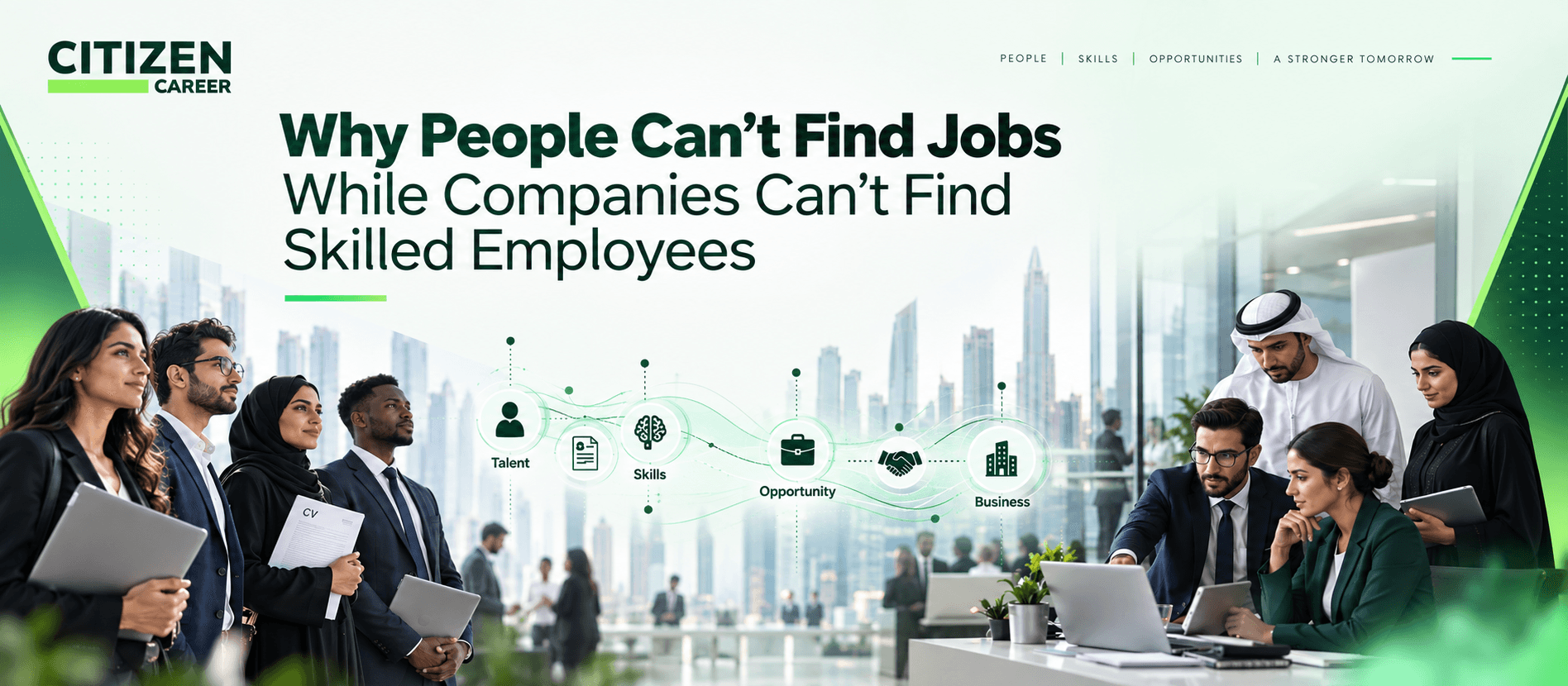
People are looking for jobs. Companies are looking for skilled employees. So why aren't they finding each other?
Across the UAE and wider GCC employment market, one challenge is becoming increasingly important: the gap between available talent and the skills businesses actually need.
Job seekers may send dozens or even hundreds of applications without receiving an offer. At the same time, employers can receive large volumes of applications but still struggle to find candidates with the right combination of technical skills, practical experience, communication, availability and role-specific capability.
This is more than a recruitment problem.
It is a talent-skill mismatch.
And closing this gap requires both employers and job seekers to rethink how hiring works.
🔎 The Employment Paradox: Jobs Are Available, But the Right Match Is Difficult
The employment market can appear contradictory.
Job seekers say:
“I have experience, qualifications and I am applying for jobs, but I am not getting hired.”
Employers say:
“We have vacancies, but we cannot find candidates with the right skills.”
Both statements can be true.
The issue is often not simply the number of jobs or the number of candidates.
The issue is whether the available talent matches the actual requirements of the job.
Think of recruitment as a connection between four elements:
Talent 👤 + Skills 🧠 + Opportunity 💼 + Business Need 🏢
When one of these elements does not align, recruitment becomes more difficult.
📊 What Is a Talent-Skill Mismatch?
A talent-skill mismatch occurs when the skills available in the labour market do not sufficiently match the skills employers require.
For example, a company may need a Customer Support Executive who can:
- Use CRM systems
- Handle customer complaints
- Work with ticketing platforms
- Meet SLA requirements
- Communicate professionally
- Analyse customer issues
- Work across email, chat and phone
The company may receive hundreds of CVs.
However, many applicants may only demonstrate:
“Customer service experience.”
There is a difference between having a job title and demonstrating the skills required to perform the job.
That difference can determine whether a candidate progresses through recruitment.
👤 Why Are Job Seekers Struggling to Get Hired?
1. Applying for Too Many Unrelated Jobs
One of the most common job-search mistakes is applying for everything.
A candidate may apply for:
- Customer Service
- Sales
- HR
- Administration
- Finance
- Operations
- Marketing
without adapting their CV or application.
This creates a weak professional positioning.
Instead of asking:
“What jobs can I apply for?”
ask:
“Which roles match my experience, skills and career direction?”
A targeted job search can make it easier to demonstrate relevance.
📄 2. Your CV May Not Clearly Demonstrate Your Skills
Your CV is often the first opportunity to communicate your professional value.
Recruiters need to understand:
- What role are you targeting?
- What have you achieved?
- What systems can you use?
- What responsibilities have you handled?
- What skills do you bring?
- What results have you delivered?
Compare:
❌ Generic
Responsible for customer service and handling customers.
✅ Specific
Managed customer enquiries through phone, email and digital channels, resolving service issues while maintaining response-time and customer satisfaction targets.
The second version provides more information about what the candidate actually does.
🤖 3. Recruitment Is Becoming More Skills-Based
Modern recruitment increasingly uses digital tools such as:
- Applicant Tracking Systems (ATS)
- Recruitment platforms
- Candidate databases
- Online assessments
- Skills screening
- Structured interviews
Therefore, candidates should create CVs that are not only visually professional but also relevant and searchable.
If a vacancy requires:
CRM + Ticketing + SLA + Complaint Resolution + Excel
and a candidate's CV only says:
“Experienced customer service professional.”
the relevant skills may not be sufficiently visible.
Your CV should speak the language of the job description.
🧠 4. Years of Experience Do Not Automatically Equal Job Readiness
A candidate may have:
8 years of experience
but not have the specific technical or operational experience required for a particular vacancy.
Another candidate may have:
3 years of highly relevant experience
and already possess the systems, processes and capabilities required.
Therefore:
Experience matters.
But relevant experience and demonstrable capability matter too.
Employers increasingly need to answer:
“Can this candidate perform the work required?”
💻 5. Employers Need Practical Skills
Different roles require different capabilities.
Customer Support
- CRM
- Ticketing systems
- Complaint management
- Communication
- SLA management
- Problem solving
Sales
- Prospecting
- Lead generation
- CRM
- Negotiation
- Pipeline management
- Closing
Finance
- Accounting systems
- Reconciliation
- Excel
- Reporting
- Financial controls
HR
- Recruitment
- HRIS
- Employee relations
- Payroll coordination
- Documentation
- UAE employment compliance awareness
Supply Chain
- Procurement
- Inventory
- ERP
- Vendor management
- Logistics
- Data analysis
The question is therefore not simply:
“How many years have you worked?”
It is:
“What can you do with those years of experience?”
🏢 Why Are Companies Struggling to Find Skilled Employees?
The challenge exists on the employer side too.
A company can advertise a vacancy and receive hundreds of applications while still struggling to identify the right person.
Here are some common reasons.
1️⃣ High Application Volume
More applications do not necessarily mean more qualified candidates.
A company may receive 500 applications but only a small percentage may meet the essential requirements.
2️⃣ Skills Do Not Match the Job
Candidates may have experience but lack the specific:
- Technical skills
- Software knowledge
- Industry experience
- Communication capability
- Leadership experience
- Problem-solving ability
required for the role.
3️⃣ Salary Expectations Are Misaligned
Employers have approved salary budgets.
Candidates have their own compensation expectations.
If those expectations are significantly different, the recruitment process may stop even when the candidate is otherwise qualified.
4️⃣ Availability and Notice Periods
A company may need someone immediately.
The strongest candidate may have a lengthy notice period.
This creates a timing mismatch.
5️⃣ International Hiring Adds Complexity
For international recruitment, employers may also need to consider:
- Work authorisation
- Visa processing
- Passport validity
- Documentation
- Relocation
- Travel
- Temporary accommodation
- Joining timelines
This can make international hiring more complex than simply selecting a CV.
🔄 Recruitment Should Be a Two-Way Process
Recruitment is not only about an employer assessing a candidate.
Candidates should also assess employers.
Candidates should understand:
- Job responsibilities
- Compensation
- Benefits
- Working conditions
- Career development
- Location
- Relocation requirements
- Employment terms
- Recruitment stages
Employers should assess:
- Technical skills
- Experience
- Communication
- Problem solving
- Behavioural competencies
- Availability
- Salary expectations
- Documentation
- Role suitability
A transparent recruitment process creates clearer expectations on both sides.
🎯 Skills-Based Hiring: A Practical Solution
One way to reduce the talent mismatch is to focus recruitment on skills and capability, rather than relying only on CVs and job titles.
A structured process can look like this:
Step 1 — Define the Role
Identify:
- Responsibilities
- Essential skills
- Preferred skills
- KPIs
- Salary range
- Location
- Experience
- Working conditions
⬇️
Step 2 — Find Relevant Talent
Search for candidates based on the actual requirements of the role.
⬇️
Step 3 — Screen
Review:
- CV
- Experience
- Skills
- Career history
- Eligibility
⬇️
Step 4 — Assess
Use role-specific assessments.
For example:
Customer Service: Customer scenario
Sales: Sales pitch
Finance: Financial case
Operations: Process scenario
HR: Employee relations case
⬇️
Step 5 — Interview
Assess:
- Technical knowledge
- Communication
- Problem solving
- Behaviour
- Motivation
⬇️
Step 6 — Verify
Where appropriate, verify relevant:
- Employment history
- Qualifications
- Documents
- References
⬇️
Step 7 — Match and Employ
Connect the candidate with the appropriate employment opportunity and complete the required employment processes.
📈 How Job Seekers Can Become More Employable
If you are searching for a job in the UAE or GCC, start with these steps.
Step 1 — Choose a Career Direction 🎯
Instead of applying to every vacancy, identify your target career path.
For example:
Customer Support → Customer Operations → Customer Success
This creates a clearer professional profile.
Step 2 — Study Real Job Descriptions 🔎
Look at multiple vacancies for the same target role.
Identify recurring requirements.
For example:
- CRM
- Excel
- Communication
- Complaint handling
- Reporting
- SLA management
These recurring requirements provide valuable insight into what employers are seeking.
Step 3 — Identify Your Skills Gap 🧠
Create three columns:
| Required Skill | Current Level | Action |
|---|---|---|
| CRM | Intermediate | Improve |
| Excel | Basic | Practice |
| Communication | Strong | Demonstrate |
| Reporting | Basic | Develop |
| Complaint Handling | Strong | Demonstrate |
Now your job search becomes a career development plan, not simply an application exercise.
📚 Certificates Are Useful — But Capability Matters
Professional certifications and courses can strengthen a CV.
But employers may still ask:
“Can you perform the task?”
Where possible, candidates should combine learning with practical evidence.
For example:
📜 Course → 💻 Practice → 📊 Project → 🗣️ Explain → 💼 Demonstrate
The goal is to move from certificate collection to capability development.
🇦🇪 Understanding the UAE Employment Market
For candidates considering employment in the UAE, the recruitment journey can involve more than finding a vacancy.
Depending on the situation, candidates may need to consider:
- Employment eligibility
- Visa/work authorisation
- Documentation
- Passport validity
- Relocation
- Salary expectations
- Notice periods
- Accommodation
- Travel
- Joining timelines
International candidates should understand the complete process before making employment or relocation decisions.
🏢 What Employers Can Do to Improve Hiring
The solution is not only for candidates.
Companies can also improve their recruitment strategy.
1️⃣ Write clearer job descriptions
Separate essential and desirable requirements.
2️⃣ Define measurable competencies
Don't simply write “good communication.”
Define what good communication means for the role.
3️⃣ Use practical assessments
Test candidates against real job scenarios.
4️⃣ Review compensation
Ensure salary expectations and business budgets are reasonably aligned.
5️⃣ Improve recruitment speed
Good candidates may be considering multiple opportunities.
6️⃣ Communicate consistently
Candidates should know where they are in the process.
7️⃣ Build talent pipelines
Do not wait until a vacancy becomes urgent.
8️⃣ Consider international talent
Where appropriate, international recruitment can expand access to specialised skills.
9️⃣ Use workforce solutions
EOR and staff augmentation can provide additional workforce infrastructure where appropriate.
🔟 Measure quality, not just quantity
A recruitment team's success should not be measured only by the number of applications received.
The quality of the final match matters.
🌍 How EOR and Staff Augmentation Can Support Workforce Growth
Companies expanding into new markets may face challenges around:
- Employment infrastructure
- Payroll
- HR administration
- Immigration
- Compliance
- Workforce deployment
- International hiring
An Employer of Record (EOR) model can provide employment infrastructure while employees perform their assigned work for the client organisation, subject to the applicable contractual and legal arrangements.
Staff augmentation can also help businesses access additional talent for specific workforce requirements without relying exclusively on traditional permanent hiring channels.
These models can be particularly relevant when companies need to scale talent while managing cross-border employment complexity.
🤝 The Citizen Approach
At Citizen, we believe the future of recruitment is not simply about collecting CVs.
It is about creating stronger connections between:
👤 People
🧠 Skills
🏢 Employers
🌍 Global Mobility
📋 HR Compliance
📈 Workforce Growth
Our approach brings together talent acquisition, employment support, immigration, payroll, HR administration and workforce solutions.
For candidates, the journey can be structured around:
Talent → CV → Assessment → Interview → Employment → Relocation → Career Growth
For employers:
Business Requirement → Talent Search → Screening → Assessment → Selection → Employment → Workforce Support
The objective is simple:
Better alignment between people and opportunities.
🚀 The Future of Hiring Is About Better Matching
The employment question should not simply be:
“Why can't people find jobs?”
Nor:
“Why can't companies find employees?”
The more useful question is:
“Why are available skills and business requirements failing to connect?”
Solving that challenge requires action from both sides.
Candidates need to:
✅ Develop relevant skills ✅ Build targeted CVs ✅ Demonstrate practical capability ✅ Understand the market ✅ Prepare for assessments ✅ Communicate professionally
Employers need to:
✅ Define roles clearly ✅ Assess relevant skills ✅ Offer realistic employment conditions ✅ Improve recruitment processes ✅ Communicate with candidates ✅ Build scalable talent strategies
🇦🇪 Your Next Career or Workforce Move Starts With the Right Match
Whether you are a professional searching for your next opportunity or a business looking for skilled talent, the first step is understanding what needs to be matched.
The right person. The right skills. The right opportunity. The right employment structure.
That is where better workforce outcomes begin.
Looking for your next opportunity?
Explore career opportunities with Citizen and take the next step in your professional journey.
Looking for skilled talent?
Speak with Citizen about EOR, global mobility, immigration, payroll, HR compliance and staff augmentation solutions designed to support workforce requirements in the UAE and beyond.
Citizen — Building Trust Through Transparency.
EOR | Global Mobility | Immigration | Payroll | HR Compliance | Staff Augmentation
🔎 SEO Information
Meta Title
Why People Can't Find Jobs & Companies Can't Find Skilled Employees | Citizen
Meta Description
Why are job seekers struggling to find jobs while companies struggle to find skilled employees? Explore the UAE talent-skill gap, recruitment challenges and practical solutions.
Suggested URL Slug
/blog/people-cant-find-jobs-companies-cant-find-skilled-employees
Primary Keyword
skilled employees in UAE
Secondary Keywords
- UAE jobs
- jobs in UAE
- skilled workers in UAE
- skilled talent UAE
- UAE recruitment
- recruitment challenges in UAE
- talent shortage UAE
- skills gap UAE
- hiring skilled employees
- UAE employment market
- talent acquisition UAE
- recruitment agencies UAE
- EOR UAE
- Employer of Record UAE
- staff augmentation UAE
- workforce solutions UAE
- international hiring UAE
- global mobility UAE
Long-Tail Keywords
- why can't I find a job in UAE
- why companies cannot find skilled employees
- why is it difficult to find skilled workers in UAE
- UAE talent shortage and skills gap
- how to get a job in UAE
- how companies can hire skilled employees in UAE
- skills-based hiring in UAE
- international employee hiring in UAE
- EOR services in UAE
- staff augmentation services in UAE
❓ Frequently Asked Questions
1. Why are people struggling to find jobs in the UAE?
Job seekers may face challenges because of competition, skills mismatch, CV positioning, salary expectations, role requirements, availability and other factors. Having experience does not always mean that a candidate's skills match the specific requirements of a vacancy.
2. Why are companies struggling to find skilled employees?
Companies may receive many applications but still have difficulty finding candidates with the right combination of technical skills, relevant experience, communication, availability and role-specific capability.
3. What is a talent-skill mismatch?
A talent-skill mismatch occurs when the skills available among job seekers do not sufficiently match the skills required by employers.
4. How can candidates improve their chances of getting a job?
Candidates can improve their employability by targeting suitable roles, tailoring their CV, developing relevant skills, preparing for assessments, improving communication and demonstrating practical capability.
5. Are qualifications enough to get a job?
Qualifications can be valuable, but employers may also assess practical skills, relevant experience, communication, problem solving and the candidate's ability to perform the specific role.
6. What is skills-based hiring?
Skills-based hiring focuses on the capabilities required to perform a job rather than relying only on academic qualifications, job titles or years of experience.
7. How can companies improve their recruitment process?
Companies can improve hiring by defining roles clearly, identifying essential skills, using practical assessments, maintaining realistic compensation expectations, communicating with candidates and reducing unnecessary recruitment delays.
8. Can international candidates find jobs in the UAE?
Yes, international candidates can pursue UAE employment opportunities where they meet the relevant employer, employment and immigration requirements. International hiring may involve additional documentation, work authorisation and relocation considerations.
9. What is an Employer of Record (EOR)?
An Employer of Record is a workforce model in which an EOR provides employment and HR infrastructure for a worker while the worker performs their assigned duties for a client organisation, subject to the applicable legal and contractual arrangements.
10. What is staff augmentation?
Staff augmentation is a workforce model that allows an organisation to add external professionals to support specific business or project requirements.
11. Can EOR help companies hire international talent?
An EOR can provide employment infrastructure such as HR administration, payroll and other employment-related support, potentially helping organisations manage international workforce requirements more efficiently.
12. How does Citizen support employers and candidates?
Citizen provides workforce-related solutions covering areas such as EOR, global mobility, immigration, payroll, HR compliance and staff augmentation, helping connect workforce requirements with employment infrastructure.
📌 Suggested FAQ Schema Questions
For implementation by the website/SEO team, the following questions can be included in FAQPage structured data where the visible FAQ content matches the schema:
- Why are people struggling to find jobs in the UAE?
- Why are companies struggling to find skilled employees?
- What is a talent-skill mismatch?
- How can candidates improve their chances of getting a job?
- Are qualifications enough to get a job?
- What is skills-based hiring?
- How can companies improve their recruitment process?
- Can international candidates find jobs in the UAE?
- What is an Employer of Record (EOR)?
- What is staff augmentation?
- Can EOR help companies hire international talent?
- How does Citizen support employers and candidates?
📣 Strong Website CTA
For Candidates 👤
Ready for your next career move?
Don't just apply for more jobs. Build a career path that matches your skills, experience and goals.
Explore Citizen career opportunities and take your next step.
CTA Button: Explore Careers
For Employers 🏢
Looking for skilled talent in the UAE or beyond?
From EOR and global mobility to immigration, payroll, HR compliance and staff augmentation, Citizen helps businesses build and manage workforce solutions.
Let's discuss your workforce requirements.
CTA Button: Talk to Citizen
Citizen
Building Trust Through Transparency.
EOR | Global Mobility | Immigration | Payroll | HR Compliance | Staff Augmentation
Written by Yasser Ammer
Expert insights on global payroll, compliance, and distributed team management from the CITIZEN EOR team.
Get global HR insights delivered to your inbox
Join thousands of founders and HR leaders staying ahead of global compliance and hiring trends.