Living Cost in UAE 2026: Dubai vs Sharjah vs Ajman | Shared vs Private Accommodation
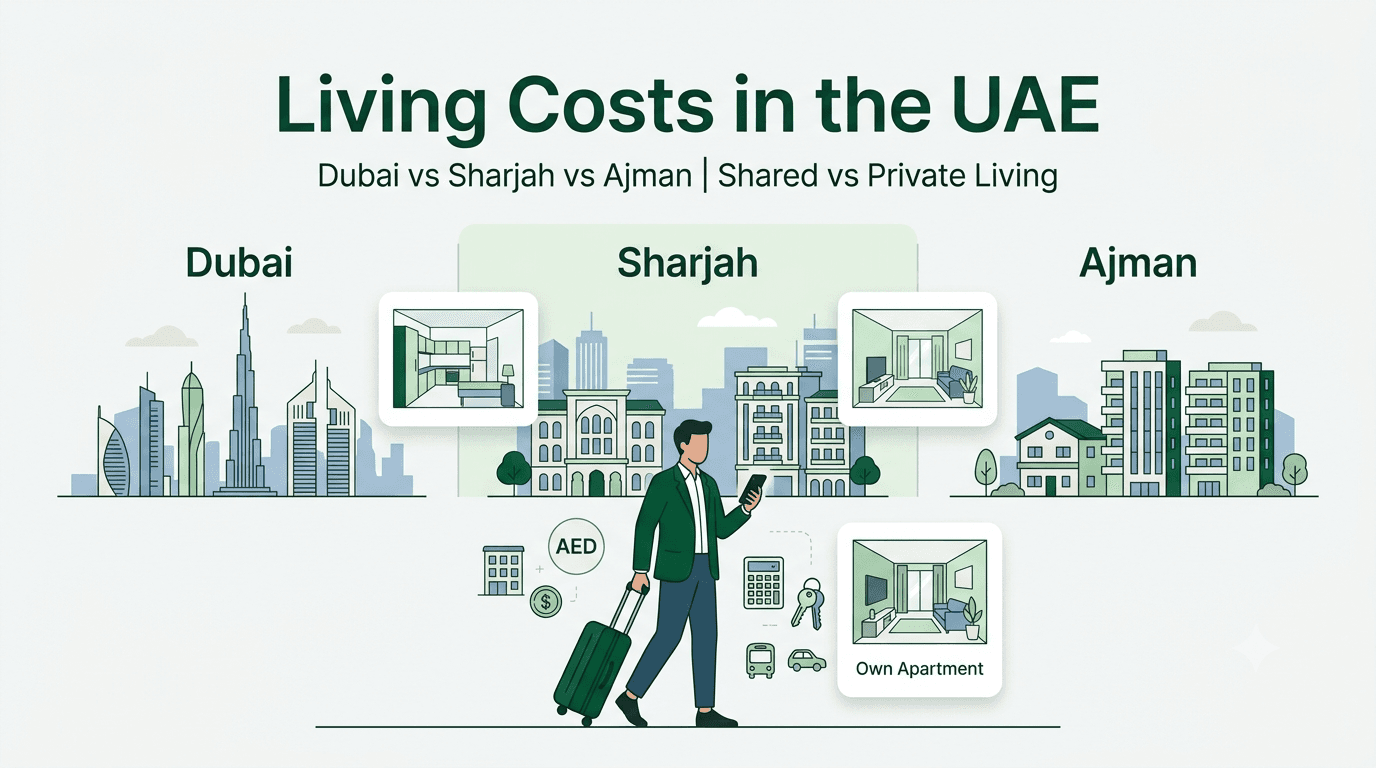
“How much will it actually cost me to live in the UAE?”
Your salary is only one part of the equation. Where you live, whether you share accommodation, how far you commute, how often you eat outside, and whether you rent your own apartment can dramatically change your monthly expenses.
For professionals working in Dubai, three popular residential choices stand out:
- Dubai — closer to major business districts and employment hubs, but generally more expensive.
- Sharjah — offers a balance between affordability, access to Dubai and family-oriented communities.
- Ajman — generally provides lower housing costs, particularly attractive to employees prioritising savings.
At the same time, the UAE's accommodation culture is evolving. Shared apartments and professionally managed shared housing are becoming important options for employees, young professionals and people relocating to the UAE, particularly during the early stages of their careers.
This guide compares Dubai, Sharjah and Ajman, explains the shared-apartment model, compares it with renting your own home, and helps you determine which option may make the most financial sense.
UAE Cost of Living at a Glance
The most important thing to understand is that housing is usually the largest controllable expense for an individual or family living in the UAE.
A professional earning AED 7,000 per month can have a very different financial experience depending on whether they:
- Share a room in Dubai
- Rent a studio in Ajman
- Rent a one-bedroom apartment in Sharjah
- Rent a one-bedroom apartment close to their Dubai workplace
The difference can easily reach thousands of dirhams every month.
Indicative monthly budget for a single professional
| Expense | Dubai | Sharjah | Ajman |
|---|---|---|---|
| Shared accommodation | AED 1,200–2,500 | AED 900–1,800 | AED 700–1,500 |
| Studio / own apartment | AED 3,300–7,000+ | AED 2,000–3,500+ | AED 1,500–2,700+ |
| Utilities & internet | AED 400–800 | AED 350–700 | AED 300–650 |
| Groceries | AED 800–1,300 | AED 700–1,200 | AED 650–1,100 |
| Transportation | AED 300–1,200+ | AED 350–1,400+ | AED 400–1,600+ |
| Mobile phone | AED 100–250 | AED 100–250 | AED 100–250 |
| Personal/leisure | AED 400–1,000+ | AED 350–900+ | AED 300–800+ |
| Typical total with shared housing | AED 3,200–7,000+ | AED 2,750–6,250+ | AED 2,450–5,900+ |
These are planning ranges, not fixed market prices. Lifestyle, location, transport method and accommodation quality can significantly change the final number.
1. Living in Dubai: Convenience Comes at a Premium
Dubai remains one of the UAE's most attractive destinations for international professionals.
It offers:
- Major employment centres
- Extensive public transportation
- Metro connectivity
- International communities
- Shopping and entertainment
- Restaurants and leisure facilities
- Proximity to major business districts
- A large selection of residential properties
However, these advantages generally come with higher housing and lifestyle costs.
Current rental data illustrates the variation within Dubai itself. Bayut's H1 2026 rental report shows affordable areas such as Al Nahda, Deira and International City offering significantly lower rents than premium and mid-tier locations such as Business Bay and Jumeirah Village Circle. For example, reported annual rents for one-bedroom apartments were around AED 56,000 in Al Nahda, AED 66,000 in Deira and AED 61,000 in International City, while JVC and Business Bay were considerably higher. ([Bayut][1])
That means even within Dubai, location can be almost as important as the emirate itself when calculating your cost of living.
Dubai housing examples
A single professional might consider:
Shared accommodation
- AED 1,200–2,500+ per month
Studio
- Approximately AED 3,300–7,000+ per month depending on location and quality
One-bedroom apartment
- Approximately AED 4,500–9,000+ per month in many popular areas
Premium neighbourhoods can be substantially more expensive.
Who is Dubai best for?
Dubai may make the most sense if:
- Your workplace is in Dubai.
- You value a short commute.
- You rely heavily on public transportation.
- Your salary comfortably supports higher housing costs.
- You want access to Dubai's business and lifestyle ecosystem.
- You prioritise convenience over maximum savings.
2. Living in Sharjah: The Middle Ground
Sharjah is one of the most popular alternatives for professionals working in Dubai.
The main attraction is straightforward:
Lower housing costs without moving as far away from Dubai as Ajman.
Popular residential areas include:
- Al Nahda
- Al Taawun
- Al Majaz
- Muwaileh
- Al Khan
- Rolla
According to Bayut's 2025 Sharjah rental market report, average annual rents in popular areas included approximately AED 26,000 for a studio and AED 43,000 for a one-bedroom apartment in Muwaileh, while Al Nahda recorded approximately AED 29,000 for a studio and AED 37,000 for a one-bedroom apartment. ([Bayut][2])
Sharjah's rental market has also experienced meaningful demand and price movement, so prospective tenants should not assume that every property will automatically be inexpensive. ([Bayut][2])
Sharjah's biggest advantage
You may save on rent compared with Dubai while remaining relatively close to Dubai's employment centres.
But there is an important trade-off:
The commute.
Traffic between Sharjah and Dubai can turn a seemingly cheap apartment into an expensive lifestyle decision if you spend significant amounts on fuel, taxis or time.
For someone commuting to Dubai six days a week, AED 1,000 saved in rent is not necessarily AED 1,000 saved overall.
You need to calculate the complete cost.
3. Living in Ajman: Maximum Housing Savings
Ajman is generally the most attractive of these three options for professionals whose primary objective is reducing accommodation costs.
Popular areas include:
- Al Nuaimiya
- Al Rashidiya
- Al Jurf
- Al Rawda
- Ajman Downtown
- Al Hamidiyah
- Emirates City
Bayut's 2025 Ajman market report showed average annual rents in Al Nuaimiya of approximately AED 18,000 for studios, AED 27,000 for one-bedroom apartments and AED 38,000 for two-bedroom apartments. Al Rashidiya showed similar affordability, with average rents of approximately AED 18,000, AED 28,000 and AED 42,000 respectively. ([Bayut][3])
Current rental-index data also shows Ajman's apartment rental market has been moving upward, so affordability should not be interpreted as permanently fixed low prices. ([Bayut][4])
Ajman's biggest advantage
Lower rent can create significantly more disposable income.
For an employee earning AED 6,000–8,000 per month, the difference between spending AED 1,500–2,000 on accommodation and AED 4,000–5,000 can materially affect savings.
The trade-off
Ajman is farther from many Dubai employment centres.
Therefore, employees should consider:
- Fuel
- Salik
- Parking
- Public transportation
- Taxi costs
- Travel time
- Vehicle maintenance
- Daily commuting fatigue
A low-rent apartment is not necessarily the cheapest option if the commute becomes expensive.
Dubai vs Sharjah vs Ajman: Housing Comparison
| Factor | Dubai | Sharjah | Ajman |
|---|---|---|---|
| Rent | Highest | Medium | Generally lowest |
| Job proximity | Excellent | Good for Dubai commuters | Lower for Dubai commuters |
| Public transport | Excellent | Good | More limited depending on area |
| Lifestyle | Very extensive | Balanced | More residential |
| Space for money | Lower | Better | Generally better |
| Saving potential | Lower | Medium–high | High |
| Commute to Dubai | Excellent if living near work | Can be challenging | Usually longer |
| Best for | Convenience & career access | Balance | Cost-conscious living |
4. The Rise of Shared Apartments in the UAE
One of the most important accommodation trends among international employees is shared living.
Instead of one person paying the full rent for an apartment, several residents share a property and divide the cost.
For example, instead of one professional paying AED 5,000 per month for an apartment, four residents might collectively cover the cost of a larger apartment.
The resident may pay for:
- A private bedroom
- A shared bedroom
- A bed space
- A room within a professionally managed apartment
depending on the accommodation model.
Shared living has historically been particularly attractive to:
- Young professionals
- Newly relocated employees
- Entry-level workers
- International employees
- Employees building initial savings
- People who have not yet decided where they want to settle permanently
5. Shared Apartment vs Renting Your Own Apartment
The difference is not simply about rent.
It is about financial flexibility, privacy, independence, convenience and lifestyle.
Shared Apartment
A shared apartment means multiple residents occupy the same residential unit and share facilities such as:
- Kitchen
- Living room
- Bathrooms
- Laundry facilities
- Utilities
- Internet
Depending on the arrangement, residents may have a private bedroom or share a bedroom.
Advantages of Shared Accommodation
1. Lower monthly cost
This is the biggest advantage.
Instead of carrying the entire rental cost, residents divide expenses.
A professional might spend:
AED 1,000–2,000/month
instead of:
AED 3,000–6,000+/month
on independent accommodation.
The exact amount depends heavily on location, room type and accommodation quality.
2. Lower initial financial pressure
Moving to the UAE can involve several expenses:
- Visa-related costs
- Transportation
- Clothing
- Mobile connection
- Food
- Deposits
- Furniture
- Household items
- Emergency expenses
Shared accommodation can reduce the amount of money required to establish yourself.
3. Easier for newly relocated employees
Someone arriving in the UAE for the first time may not immediately know:
- Which area is best
- Where their permanent workplace will be
- How long their commute will take
- Which neighbourhood fits their lifestyle
- Whether they want to stay in Dubai, Sharjah or Ajman
Shared accommodation can provide flexibility while they settle in.
4. Utilities may be easier to manage
In some professionally managed arrangements, utilities and internet are included in the monthly accommodation fee.
That can make budgeting simpler.
However, residents should always confirm exactly what is included before signing an agreement.
5. Social environment
Shared accommodation can help newly arrived professionals build social connections.
For someone arriving alone, living with other professionals can reduce the initial isolation associated with relocation.
6. Disadvantages of Shared Accommodation
Shared living is not perfect.
1. Limited privacy
You may share:
- Kitchen
- Bathroom
- Living room
- Laundry
- Common areas
For some people, this can become frustrating over time.
2. Different lifestyles
One person may work during the day.
Another may work night shifts.
Another may enjoy having friends over.
Another may prefer a quiet home.
These differences can create conflict.
3. Less control
You generally cannot control:
- Cleaning standards
- Noise
- Guests
- Kitchen usage
- Common-area behaviour
- Household routines
unless clear house rules exist.
4. Quality can vary dramatically
Not every shared apartment is professionally managed.
Some properties may have:
- Excessive occupancy
- Poor maintenance
- Insufficient facilities
- Lack of privacy
- Unclear tenancy arrangements
Therefore, cheap does not always mean good value.
7. Renting Your Own Apartment
Renting your own studio or one-bedroom apartment provides substantially more independence.
You control:
- Your space
- Your schedule
- Your guests
- Your furniture
- Your lifestyle
- Your privacy
For couples, families and established professionals, independent accommodation can be much more practical.
8. Advantages of Renting Your Own Home
Privacy
You have your own residential environment.
There is no need to coordinate your schedule around roommates.
Independence
You control the way your home is used.
Better for couples and families
A private apartment provides:
- More space
- Greater privacy
- Better routine
- Family-friendly environment
Long-term stability
If you know you will remain in the UAE for several years, renting your own home may make more sense than repeatedly changing shared accommodation.
Personal comfort
Your home becomes your own space rather than simply a place to sleep.
9. Disadvantages of Renting Your Own Apartment
The primary disadvantage is cost.
You may have to cover:
- Annual rent
- Security deposit
- Agency fees where applicable
- Utilities
- Internet
- Furniture
- Maintenance-related expenses depending on the agreement
- Parking
- Moving costs
A person paying AED 1,500 for shared accommodation could potentially pay AED 3,500–6,000+ for an independent studio or one-bedroom apartment.
That difference can become:
AED 24,000–54,000+ per year.
This is why accommodation decisions should be treated as a major financial decision rather than simply a lifestyle choice.
10. Shared Apartment vs Own Apartment: Complete Comparison
| Factor | Shared Apartment | Own Apartment |
|---|---|---|
| Monthly cost | Lower | Higher |
| Privacy | Limited–medium | High |
| Independence | Medium | Very high |
| Initial financial pressure | Lower | Higher |
| Utilities | Often shared/included | Usually your responsibility |
| Furniture | Often provided | May need to furnish |
| Social interaction | High | Lower |
| Flexibility | High | Medium |
| Suitable for families | Usually less suitable | Highly suitable |
| Suitable for newly relocated workers | Excellent | Moderate |
| Long-term comfort | Depends on roommates | Generally higher |
| Savings potential | High | Lower |
11. A Practical Example: AED 7,000 Salary
Imagine an employee earns:
AED 7,000 per month
Option A: Shared accommodation in Dubai
| Expense | Monthly |
|---|---|
| Shared accommodation | AED 1,600 |
| Food & groceries | AED 1,000 |
| Transportation | AED 600 |
| Mobile | AED 150 |
| Personal expenses | AED 500 |
| Miscellaneous | AED 350 |
| Total | AED 4,200 |
| Potential balance | AED 2,800 |
This employee could potentially save a meaningful portion of their income.
Option B: Own studio in Sharjah
| Expense | Monthly |
|---|---|
| Studio rent equivalent | AED 2,500 |
| Utilities & internet | AED 600 |
| Food & groceries | AED 1,000 |
| Transportation | AED 800 |
| Mobile | AED 150 |
| Personal expenses | AED 500 |
| Miscellaneous | AED 350 |
| Total | AED 5,900 |
| Potential balance | AED 1,100 |
The employee has significantly more privacy but less disposable income.
Option C: Own studio in Dubai
| Expense | Monthly |
|---|---|
| Studio rent equivalent | AED 4,000 |
| Utilities & internet | AED 700 |
| Food & groceries | AED 1,100 |
| Transportation | AED 500 |
| Mobile | AED 150 |
| Personal expenses | AED 500 |
| Miscellaneous | AED 350 |
| Total | AED 7,300 |
In this illustrative scenario, independent living in Dubai could exceed the employee's monthly salary before savings or unexpected expenses.
The lesson is important: your salary should determine your accommodation strategy.
12. The Commute Factor: The Hidden Cost
One mistake many new UAE residents make is looking only at rent.
Suppose:
Dubai apartment
Rent: AED 4,000 Transport: AED 400
Combined: AED 4,400
Ajman apartment
Rent: AED 2,000 Transport: AED 1,500
Combined: AED 3,500
Ajman still saves AED 900.
But now consider another employee:
Dubai apartment
Rent: AED 4,500 Transport: AED 300
Combined: AED 4,800
Ajman apartment
Rent: AED 2,000 Transport: AED 2,000
Combined: AED 4,000
The saving is now only AED 800.
Then consider the value of several hours spent commuting every week.
This is why the best housing decision is not necessarily:
“Where is rent cheapest?”
It is:
“Where is my total cost of living lowest while maintaining a reasonable quality of life?”
13. Shared Housing Is Changing — Especially in Dubai
There is an important regulatory development that anyone considering shared accommodation in Dubai should understand.
Dubai Law No. 4 of 2026 establishes a formal framework for regulating shared housing. The law defines shared housing, establishes requirements for permits, occupancy limits and registration, and aims to reduce overcrowding and unregulated shared accommodation. It also states that shared-housing units require the appropriate permit and that rental arrangements must comply with the applicable framework. ([Dubai Land Department][5])
The law is scheduled to come into force after 180 days from publication. ([Dubai Land Department][5])
What does this mean for employees?
Shared accommodation should not simply be evaluated based on price.
Employees should also consider:
- Whether the accommodation is legally permitted
- Occupancy levels
- Safety
- Contract documentation
- Who manages the property
- What is included in the rent
- Privacy arrangements
- Maintenance responsibilities
- Registration requirements
The future of shared accommodation in Dubai is likely to be more structured, transparent and professionally managed.
That is important for both employees and employers.
14. Which City Should You Choose?
There is no single answer for everyone.
Choose Dubai if:
Your priority is convenience.
Dubai is particularly suitable if you:
- Work in Dubai
- Have a higher salary
- Want to minimise commuting
- Depend on public transportation
- Prefer an active urban lifestyle
Choose Sharjah if:
Your priority is balance.
Sharjah can be attractive if you:
- Work in Dubai but want lower rent
- Want more space for your money
- Are supporting a family
- Want access to Dubai without paying Dubai rents
- Can tolerate a longer commute
Choose Ajman if:
Your priority is savings.
Ajman can be particularly attractive if you:
- Have a moderate salary
- Want lower accommodation costs
- Work remotely or outside central Dubai
- Have your own vehicle
- Are willing to accept a longer commute
15. Which Accommodation Model Is Best for Different Salaries?
A useful rule of thumb is to think about housing as a percentage of income.
Salary: AED 4,000–6,000
Shared accommodation is often the more financially sustainable option.
The objective should be:
Keep housing costs low → build emergency savings → establish yourself in the UAE.
Salary: AED 6,000–9,000
You have more choices.
Depending on your location and lifestyle, you could consider:
- Premium shared accommodation
- Private room
- Affordable studio
- Sharjah studio
- Ajman one-bedroom apartment
Salary: AED 9,000–15,000
Independent accommodation becomes increasingly realistic.
You can consider:
- Dubai studio
- Dubai one-bedroom
- Sharjah one-bedroom
- Larger shared accommodation for greater savings
Salary: AED 15,000+
Housing becomes more of a lifestyle decision.
You can prioritise:
- Location
- Community
- Space
- Building quality
- Facilities
- School access
- Commute
- Privacy
rather than simply choosing the cheapest available option.
16. Don't Forget the Non-Rent Expenses
Your UAE budget should include more than rent.
Food
Cooking at home can significantly reduce monthly spending.
A single professional might budget approximately:
AED 700–1,300 per month
depending on dietary habits and how frequently they eat outside.
Transportation
Costs can vary dramatically depending on whether you use:
- Metro
- Bus
- Taxi
- Personal vehicle
- Ride-hailing
- Employer transportation
Someone living farther from work may save on rent but spend considerably more on transportation.
Utilities
Depending on the property and usage, consider:
- Electricity
- Water
- Cooling/air conditioning
- Internet
- Mobile
- Gas where applicable
Lifestyle
Entertainment can quickly increase your monthly expenses.
Restaurants, cafés, shopping, gyms, weekend trips and social activities should be included in your budget.
17. A Simple UAE Housing Rule
Before choosing accommodation, calculate:
Monthly Housing Cost + Monthly Transportation Cost = True Housing Cost
For example:
Dubai
AED 4,000 rent + AED 500 transport = AED 4,500
Sharjah
AED 2,500 rent + AED 900 transport = AED 3,400
Ajman
AED 2,000 rent + AED 1,500 transport = AED 3,500
Suddenly, the decision becomes much clearer.
18. Shared Living or Your Own Home?
The answer depends on your stage of life.
If you are newly relocating:
Shared accommodation can make sense.
It allows you to:
- Reduce expenses
- Build savings
- Learn the UAE
- Understand your workplace location
- Decide where you eventually want to live
If you are established:
Your own apartment may make more sense.
You may value:
- Privacy
- Comfort
- Stability
- Personal space
- Better lifestyle
If you are relocating with family:
Independent accommodation is usually the more practical choice.
The requirements are fundamentally different from those of a single professional.
19. The Smartest Approach for New UAE Employees
For many employees relocating to the UAE, the most financially sensible strategy is not immediately signing an expensive long-term apartment.
Instead:
Phase 1 — Establish yourself
Consider affordable shared accommodation or a professionally managed room.
Phase 2 — Understand your workplace
Determine your actual commute.
Phase 3 — Build savings
Create an emergency fund and understand your monthly spending pattern.
Phase 4 — Upgrade strategically
Once your income and expenses are stable, consider moving into your own studio or one-bedroom apartment.
This approach can reduce financial pressure during the first few months of relocation.
20. How Citizen Helps Employees Relocating to the UAE
Relocating for a new job involves much more than receiving an employment contract.
Employees need to understand:
- Where they will live
- How much they should budget
- How transportation affects their expenses
- What documentation is required
- How UAE employment and immigration processes work
- How to plan their first months in the country
At Citizen, our role goes beyond connecting talent with opportunities.
We support businesses and international professionals with Employer of Record (EOR), employment, visa and immigration coordination, payroll, compliance and relocation-related support across the GCC.
For employees relocating to the UAE, understanding the difference between salary and actual disposable income is critical.
A salary of AED 7,000 can feel very different depending on whether you spend AED 1,500, AED 3,000 or AED 5,000 on housing.
That is why relocation planning should begin before you move, not after you arrive.
Final Thoughts: Choose the Lifestyle That Fits Your Salary
There is no universally “best” place to live in the UAE.
Dubai offers convenience, connectivity and proximity to employment centres — but generally at a higher cost.
Sharjah provides a strong balance between affordability, space and access to Dubai.
Ajman can offer some of the UAE's more affordable residential options, particularly for professionals focused on saving.
And when it comes to accommodation:
Shared living is primarily a financial strategy.
Private renting is primarily a privacy and lifestyle strategy.
For someone starting a new career in the UAE, shared accommodation can provide an effective way to reduce expenses and build savings. Once income increases and priorities change, moving into your own apartment can provide greater comfort and independence.
The smartest decision is therefore not simply to ask:
“Where is the cheapest place to live?”
Instead, ask:
“Where can I achieve the best balance between rent, transportation, salary, savings, privacy and quality of life?”
That is the calculation that turns a UAE salary into a sustainable UAE lifestyle.
Written by Yasser
Expert insights on global payroll, compliance, and distributed team management from the CITIZEN EOR team.
Get global HR insights delivered to your inbox
Join thousands of founders and HR leaders staying ahead of global compliance and hiring trends.