Will AI Replace Customer Service? Why the Human Touch Still Matters
AI is transforming customer service—but is it replacing people, or simply changing what people do?
Artificial intelligence is rapidly changing the way businesses communicate with their customers. AI-powered chatbots, virtual assistants, automated workflows, predictive analytics, and intelligent customer support platforms are becoming increasingly common across industries.
For businesses, the attraction is clear: AI can operate around the clock, respond instantly, process enormous amounts of information, and automate repetitive customer interactions.
But this raises an important question:
If AI can answer customers, solve routine problems, and work 24/7, will businesses still need customer service professionals?
The answer is not simply yes or no.
AI will automate many customer service tasks. But customer service itself is much bigger than answering questions.
It involves understanding people, handling emotions, applying judgment, resolving complex problems, taking ownership, and building relationships.
That is where the human touch continues to matter.
AI Is Changing Customer Service—Not Simply Replacing It
There is no question that AI can perform many customer service activities efficiently.
AI can:
- Answer frequently asked questions
- Provide 24/7 first-line support
- Retrieve customer and product information
- Categorise and route requests
- Summarise previous customer interactions
- Suggest responses to customer service agents
- Analyse customer feedback
- Translate conversations
- Identify patterns in customer interactions
- Automate repetitive administrative tasks
For organisations handling thousands—or millions—of customer interactions, this can significantly improve operational efficiency.
Instead of asking a customer service professional to spend several minutes answering the same basic question repeatedly, an AI system can potentially provide the information instantly.
But speed is only one part of customer experience.
Customers Are Not Always Looking for an Answer
Some customer interactions are straightforward.
"What are your opening hours?"
"Where is my order?"
"How do I reset my password?"
"What documents do I need?"
These are situations where automation can be extremely useful.
But consider another situation.
A customer has received the wrong product after waiting several weeks.
Another customer has been charged unexpectedly.
A business client has experienced a technical issue that has affected its operations.
A customer has contacted the company several times without receiving a satisfactory resolution.
In these situations, the problem is not simply informational.
The customer may be frustrated, disappointed, anxious, or angry.
They may want someone to understand what happened, take ownership, explain the situation, and find an appropriate solution.
That is where human interaction becomes particularly valuable.
AI vs Human: Where Does Each Add Value?
The future of customer service is not necessarily about choosing AI or humans.
It is about understanding where each performs best.
Note: The chart is an illustrative framework designed to explain relative strengths, not a statistical measurement of AI or human performance.
AI vs Human Customer Service
| Customer Service Activity | AI | Human | Suitable Model |
|---|---|---|---|
| FAQs & basic information | ✓ | ✓ | AI-led |
| Order/status updates | ✓ | ✓ | AI-led |
| 24/7 first-line support | ✓ | — | AI-led |
| Customer history & data retrieval | ✓ | ✓ | AI-assisted |
| Simple troubleshooting | ✓ | ✓ | AI-led / assisted |
| Complex complaints | △ | ✓ | Human-led |
| Emotional or sensitive situations | △ | ✓ | Human-led |
| Exceptions to standard policy | △ | ✓ | Human-led |
| Escalations | ✓ | ✓ | Human-led |
| Relationship management | △ | ✓ | Human-led |
| Customer analytics | ✓ | ✓ | AI-assisted |
| Final judgment and accountability | △ | ✓ | Human-led |
✓ = strong capability | △ = can assist but has limitations
The Human Touch Is About More Than Saying "Sorry"
Human customer service is not valuable simply because humans can express empathy.
It is valuable because people can apply context, judgment and accountability.
A skilled customer service professional can listen to what a customer is saying—and understand what the customer actually needs.
They can:
- Ask relevant follow-up questions
- Understand the context behind a complaint
- Recognise when a standard process is not appropriate
- Make judgment-based decisions
- Coordinate with other departments
- Negotiate appropriate solutions
- Manage escalations
- Take ownership of difficult cases
- Balance policy with individual circumstances
- Build trust during challenging interactions
Not every customer problem fits neatly into a predefined workflow.
Sometimes the right answer is not in the script.
That is when experience and human judgment become particularly important.
The Future Is Not AI vs Humans
One of the biggest mistakes businesses can make is treating the future of customer service as a competition:
AI OR Human
A more useful question is:
AI + Human: How can technology and people work together?
Imagine a customer contacts a company about a complicated issue.
AI can immediately:
- Identify the customer
- Retrieve previous interactions
- Summarise the customer's history
- Check relevant policies
- Analyse the issue
- Suggest potential solutions
The customer service professional can then focus on what matters most:
understanding the customer and resolving the problem.
Instead of spending valuable time searching multiple systems or writing repetitive notes, the employee can concentrate on communication, judgment, and resolution.
This creates a different model of customer service.
AI handles the efficiency.
Humans handle the complexity.
Together, they support the customer experience.
What AI Can Do Better
AI has several characteristics that make it particularly useful in customer operations.
1. Speed
AI can process and respond to many routine requests almost instantly.
2. Availability
AI-powered support can operate around the clock, including outside traditional business hours.
3. Consistency
Automated systems can provide standard information consistently.
4. Data Processing
AI can process large quantities of customer information and identify patterns quickly.
5. Agent Assistance
AI can help employees find information, summarise cases, recommend responses, and navigate procedures.
6. Scalability
AI can help organisations manage fluctuations in customer demand without requiring every interaction to be handled manually.
These capabilities can reduce repetitive work and allow customer service professionals to focus on higher-value interactions.
What Humans Still Bring to Customer Service
Technology may become increasingly capable, but there are areas where human involvement remains particularly important.
Empathy
Customers do not always communicate their emotions directly. Human professionals can recognise frustration, uncertainty, urgency, and dissatisfaction and adjust their communication accordingly.
Judgment
Not every situation fits a predefined rule.
Accountability
When something goes seriously wrong, customers often want to know that someone is taking ownership.
Relationship Building
Long-term customer relationships depend on trust, communication, consistency, and understanding.
Complex Problem Solving
Some cases involve multiple departments, unusual circumstances, competing priorities, or incomplete information.
Communication
Explaining a complicated issue clearly and calmly remains a critical customer service skill.
The Customer Service Equation Is Changing
The traditional model often looks like this:
Customer → Customer Service Agent → Solution
The emerging model may look more like:
Customer → AI → Information & Context → Human Agent → Resolution
AI becomes the first layer of support, while people become the decision-making and relationship layer for situations that require human involvement.
This does not mean every customer must speak to a human.
It means the business should identify which interactions require a human and which can be efficiently automated.
Real-World Examples: AI + Human Support
| Customer Situation | What AI Can Do | What the Human Adds |
|---|---|---|
| "Where is my order?" | Retrieve tracking information | Step in if delivery fails |
| "How do I reset my password?" | Provide instructions | Handle unusual technical problems |
| "I was charged twice." | Identify transaction details | Investigate and resolve the dispute |
| "I've contacted you three times." | Summarise previous interactions | Take ownership and manage escalation |
| "Your service affected my business." | Gather relevant information | Understand impact and coordinate resolution |
| "I want to cancel because I'm extremely dissatisfied." | Explain the cancellation process | Understand the underlying concern and determine appropriate next steps |
The important distinction is not whether AI or humans can perform a task.
It is whether they are the most appropriate resource for that particular customer situation.
What Could the Future Customer Service Team Look Like?
The customer service department of the future may look very different from the traditional call centre.
| Traditional Customer Service | AI-Enabled Customer Service |
|---|---|
| Agents answer repetitive questions | AI handles many routine questions |
| Agents search multiple systems | AI brings relevant information together |
| Manual case summaries | Automated conversation summaries |
| Reactive escalation | AI can flag potential escalation signals |
| Significant time spent on administration | More time available for customers |
| Human handles almost everything | AI and humans work together |
| Capacity closely tied to manual effort | Technology supports greater scalability |
The objective is not simply to reduce the number of people.
The objective is to increase the value of every customer service interaction.
The Customer Service Professional of the Future
AI will change the role of customer service professionals.
The job is unlikely to remain focused primarily on answering repetitive questions.
Instead, employees will increasingly become AI-enabled customer experience professionals.
They may spend less time searching for information and more time:
- Handling complex cases
- Managing escalations
- Building customer relationships
- Making judgment-based decisions
- Supporting frustrated customers
- Managing exceptions
- Analysing customer feedback
- Improving processes
- Working alongside AI systems
This means the skills required for customer service are also evolving.
Technical knowledge will remain important.
But communication, critical thinking, emotional intelligence, problem-solving, adaptability, and judgment will become increasingly valuable.
The future customer service skill set:
Communication + Empathy + Critical Thinking + Problem Solving + Judgment + Adaptability + AI Literacy
The customer service professional of tomorrow may therefore be less of a script reader and more of a problem solver.
AI Can Actually Make Customer Service More Human
The conversation around AI sometimes assumes that automation automatically makes customer service less personal.
It does not have to.
Used correctly, AI can actually give customer service professionals more time to be human.
If an employee no longer needs to spend hours answering repetitive questions, manually searching databases, or preparing routine case summaries, they can dedicate more attention to customers who genuinely need human assistance.
This creates an important principle:
Automate the repetitive. Augment the professional. Humanise the experience.
A New Customer Service Model
The future may involve a layered support structure.
Level 1 — AI Self-Service
Simple questions, routine requests, status updates, basic troubleshooting, and information retrieval.
↓
Level 2 — AI-Assisted Human Support
AI gathers information, summarises the situation, and provides recommendations while a customer service professional manages the interaction.
↓
Level 3 — Human-Led Resolution
Complex complaints, sensitive situations, exceptions, escalations, and relationship-critical interactions are managed by experienced professionals.
This model combines technology-driven efficiency with human-led judgment.
Why Businesses Will Still Need Customer Service Professionals
Technology can automate processes.
But businesses still need people to manage relationships.
A company's reputation is influenced not only by how quickly it answers a customer, but also by how it responds when something goes wrong.
That moment can be more important than a routine interaction.
A customer may not remember how quickly a chatbot answered a basic question.
They are much more likely to remember whether the company took their difficult problem seriously.
That is why customer service professionals remain an important part of the customer experience.
The Real Question Isn't "Will AI Replace Customer Service?"
The better question is:
"How will AI change the role of customer service professionals?"
AI will continue to automate repetitive tasks.
It will improve access to information.
It will support customer service teams.
It will change workflows.
It will reshape many traditional customer service roles.
But businesses will continue to need people—particularly when customers require understanding, judgment, accountability, communication, and relationship management.
The customer service professional of tomorrow may not compete with AI.
They may work with it.
The Human Touch Still Has a Place
Technology can provide an answer.
People can understand the situation behind the question.
AI can process information.
People can apply judgment.
AI can automate interactions.
People can build relationships.
AI can improve efficiency.
People can provide accountability.
The future of customer service is therefore unlikely to be purely human or purely artificial intelligence.
It will be a combination of both.
AI can make customer service faster.
Human professionals can make it more meaningful.
Together, they can create a better customer experience.
At Citizen, we believe the future of work is not about choosing between people and technology. It is about creating the right combination of people, processes, and technology to help businesses deliver better outcomes.
As customer expectations evolve, organisations will need customer service teams that are not only capable of using technology, but also capable of delivering the human connection that technology cannot fully replace.
The technology may change. The importance of human connection does not.
Key Takeaway
AI is not necessarily the end of customer service. It is the beginning of a new customer service model.
The organisations that adapt successfully will not simply ask:
"How much customer service can we automate?"
They will ask:
"Where can AI create efficiency, and where can our people create greater value?"
That is where the future of customer service is being built.
Written by Yasser Ammer
Expert insights on global payroll, compliance, and distributed team management from the CITIZEN EOR team.
Related Articles
Frequently Asked Questions About Staff Augmentation and Staff Outsourcing
Staff augmentation and staff outsourcing provide businesses with flexible ways to access talent, manage workforce capacity, and improve operational efficiency. While staff augmentation adds skilled professionals to an existing team with greater client control, staff outsourcing transfers responsibility for specific functions or operations to an external provider. Understanding the differences helps businesses choose the right workforce model based on their goals, budget, level of control, and operational needs—particularly when expanding across the GCC.
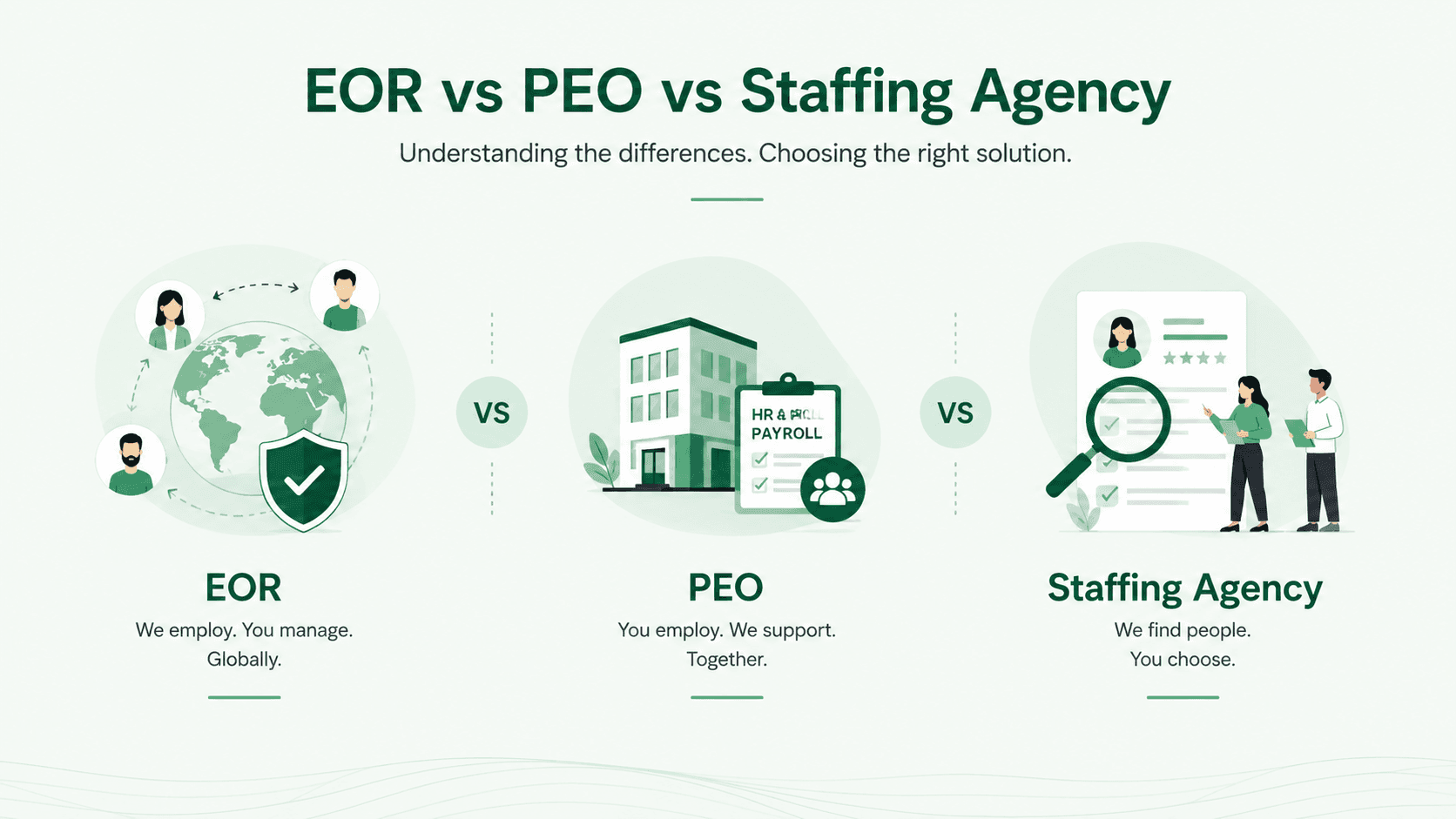
EOR vs PEO vs Staffing Agency: Key Differences Explained (2026)
Understanding the differences between an Employer of Record (EOR), Professional Employer Organization (PEO), and Staffing Agency is essential for choosing the right hiring strategy. While an EOR enables businesses to hire internationally without establishing a local entity, a PEO supports companies that already have a legal presence by managing HR functions. A Staffing Agency, on the other hand, focuses primarily on recruiting temporary or permanent talent. This guide compares each model, highlights their benefits and use cases, and explains how Citizen helps businesses hire globally with compliant EOR, payroll, and workforce solutions.

The True Cost of Hiring an Employee in the UAE: A Complete Employer Guide
Hiring in the UAE involves far more than an employee’s monthly salary. Employers must account for the full cost of employment, including recruitment, work permits, immigration, medical fitness, Emirates ID, residency, health insurance, relocation, payroll, employee benefits, equipment and ongoing HR administration. This guide helps HR leaders, finance teams and business owners understand the true cost of hiring in the UAE, identify often-overlooked expenses and plan the employee onboarding journey more effectively. For international companies, understanding these costs upfront is especially important when relocating talent into the UAE.
Get global HR insights delivered to your inbox
Join thousands of founders and HR leaders staying ahead of global compliance and hiring trends.